
One Earth – Environmental Short Film
One Earth is an environmental short film I created and edited to help raise awareness about our impact on our environment day to day.
One Earth – Environmental Short Film by Romain Pennes

One Earth is an environmental short film I created and edited to help raise awareness about our impact on our environment day to day.
One Earth – Environmental Short Film by Romain Pennes

By Marc Easton – Senior Structural Engineer – Arup
There are many reasons, from heritage to environmental, why building tall isn’t always the right approach. And yet the unparalleled opportunities tall buildings provide, especially in light of a growing dependence on cities, means their popularity continues to reach new heights. Among other advantages, skyscrapers provide solutions to high-density areas, freeing up other zones for natural and low-rise neighbourhoods and decreasing urban energy use (Resch & al, 2016).

According to the UN, last year 56.2% of the world’s population was urban, with 83.6% of North Americans living in cities. This is set to increase, with 70% of the world’s population expected to live in urban areas by 2050. With the modern city relying on the skyscraper to function, this expansion of urban living means we will inevitably become more and more dependent on tall buildings.
Therefore, as we look to tackle the climate crisis, questioning the construction of skyscrapers is narrowminded. The real focus must be on how they can be built in the most appropriate and sustainable manner.
This means futureproofing tall buildings – recognising their functionality while avoiding vanity projects. This approach will ensure projects retain their value for the next 100+ years. Fortunately, history proves the longevity of tall buildings – no building above 220m has been voluntarily demolished. Where they have been, it has generally been because the potential value of a new building on the site outweighed the value of the current asset.
Tall buildings have a key role to play in a sustainable city and so we need to make it as easy as possible for future users to adapt them as they see fit. Let us then look at three ways we can influence a tall building’s potential value at the design stage, giving it every chance of being retained for decades to come.

Flexibility
The superstructure of a new building can contribute to half its up-front embodied carbon, with the foundations contributing another 25%. We should therefore focus on persuading future users not to remove them and instead encourage repurposing. This means that considering flexible usage at the design stage is vital.
Sustainably-designed floors can become more efficient by minimising the quantity of materials used – and, in turn, embodied carbon. Floor loads should be reduced based on realistic predictions, whilst also factoring in high point loads and hotspots. These zones can provide the flexibility for future use or construction without wasting material on the entire floorplate.
https://www.weforum.org/agenda/2020/11/global-continent-urban-population-urbanisation-percent/
https://www.independent.co.uk/asia/cities-skyscrapers-world-bank-b1858063.html
Vertical structures and foundations can accommodate flexibility with lower impact. Designing these elements with capacity in reserve allows for greater adaptability, as well as capacity for possible increased wind loads resulting from climate change. This is particularly important for foundations that are difficult, if not impossible, to strengthen.
Our aim should always be to achieve long life and avoid demolition. However, if a tall building is demolished, we want to ensure that any remaining parts are reusable. Even small changes can make a big difference in increasing the resilience of buildings for the future.

Deterioration
At more than £500/m2 GFA, one of the most expensive items during a tall building renovation is the façade’s potential replacement. Fortunately, considering specification during design can help extend its useable life and reduce later costs. In addition, circular economy principles are driving the market and in turn improving its performance. An example is 1 Triton Square in London, where 3500m2 of façade panels were refurbished and reused. Compared to the new build alternative, this contribution helped towards the total saving of 40,000t CO2.
Applying appropriate specification control during construction with a good maintenance schedule helps prevent severe deterioration of the structure – which is avoidable when managed correctly. For example, concrete has the potential to last much longer than its initial design life through tweaks such as using an appropriate cover, while steel should be painted to the right specification and timber kept away from water. These are easy wins for any building, not just those over 200m.
Information
Technology has never been more accessible and at such low cost. But to reap the rewards, we need to take full advantage of its capabilities by feeding back once a building is operational. Almost every building today is designed and documented using a BIM package. We share these models throughout the design process, but they are often forgotten after completion. We should be asking for these design models to be converted to as-builts, as well as creating a digital twin of the final building, including data on all systems and elements. These can be saved in the cloud to ensure information is always available and backed-up. This technology is already in use through Arup’s Neuron system, implemented on One Taikoo Place in Hong Kong.
Furthermore, hard stamping or using radio-frequency identification tags on structural components or equipment are quick and easy ways to link to specifications, material certificates or even directly into the 3D model. Harnessing and monitoring live data could prove incredibly powerful in supporting a change of load further down the line, increasing the flexibility of the building and justifying more efficient building codes of the future. These could even be used in foundations to explain reuse or in the stability structure to evaluate the building’s health after storms or earthquakes.
Looking ahead
Skyscrapers are engineering and architectural feats that reflect the power of human ingenuity. Now they have an additional purpose. In a post-pandemic world and in the age of climate change, skyscrapers showcase what future buildings must be: flexible, resilient and smart.
When designed and built correctly, tall buildings are vital to increase city density while facilitating a long-term and sustainable built environment. In contrast, poorly designed or executed tall buildings can undermine positive work in our cities. They can even be actively detrimental to our social wellbeing. It is therefore integral that we get tall buildings right, thereby bringing our sustainable cities of the future into being.
Words By Marc Easton – Senior Structural Engineer – Arup
Works Cited
Resch, E., & al, e. (2016). Impact of urban density and building height on energy use in cities. Build Green and Renovate Deep (pp. 1-15). Tallin and Helsinki: Elsevier.

The museum invites visitors to explore how designers are redefining fashion, construction, food, electronics, packaging and more through over 300 objects, by designing out waste and creating a more circular economy.
The first section of the exhibition ‘Peak Waste’ confronts visitors with the epic scale of global waste – making the case for urgent change. Shining a light on how mass production and our consumption habits contribute to growing landfills, visitors will be able to follow their rubbish across the globe through a large-scale waste tracker. The exhibition examines how we arrived at today’s throwaway culture, one in which 80% of products are thrown away in their first six months of life.


From then on, the exhibition focuses on solutions and new thinking. Moving into ‘Precious Waste’, visitors will learn more about the raw materials used in everyday products through object deconstructions by Studio Drift as well as the designers leading the way in recycling waste into new resources. These include sustainable materials in fashion by Stella McCartney, Adidas and Bethany Williams; to construction materials such as the K Briq by Kenoteq, which uses almost 90% less carbon than regular brick, and new lives for plastic like the S-1500 chair by Snohetta, made from discarded fishing nets.
In ‘Post Waste’ discover proposals for new circular methods of production, with a focus on grown rather than extracted materials. Visitors will see experimental designs that introduce a whole new world of clothing, products and packaging made from natural materials such as coconut, algae, and corn husks. Fernando Laposse’s The Dogs bench uses raw fibres from the leaves of the Agave plant and The Blast Studio’s 3D printed column, made with waste and the fungus Mycelium, promotes a no-waste architecture.


This section also delves into how we can change our systems and behaviours to consume less. It examines models of sharing, labelling, and design-for-disassembly, which can help objects last for longer, be repaired and significantly reduce how much is manufactured and discarded. From local solutions like Kamikatsu, a Zero Waste Town in Japan to a display of tool sharing libraries across the world, the exhibition will promote living without waste and imagines a more resourceful world for future generations.
Gemma Curtin, Waste Age Curator said:
“We must face the problem of waste – we can no longer ignore what happens to things when we get rid of them. Instead of thinking of objects as things that have an end life, this exhibition proposes that they can have many lives. This is not just an exhibition it is a campaign #EndTheWasteAge, and we all have an active part in our future. The exhibition will show design is at the forefront of sustainable solutions.”
Justin McGuirk, Chief Curator and Waste Age Co-Curator, said:
“Design has helped create our wasteful society, and it will be crucial in building a cleaner future. That means rethinking the lifestyles and materials that do so much damage. This optimistic exhibition demonstrates the energy and ingenuity being applied to the challenge – and we want it to mark a turning point. There is so much we can do, but it begins with understanding our waste.”
The exhibition concludes with an interactive installation aimed at connecting visitors with the hidden life of a forest by the Sony Design Centre Europe. As the visitor moves across the screen, organic life lights up in sync with her movement, accompanied by a responsive soundtrack by sound artist Mergrim.
Alongside the exhibition is the Aurora installation, on display in the museum’s Atrium from 18 October to 14 November. Aurora is an interactive experimentation of how we can achieve a new, sustainable approach to life in the future. Conceived and created by Mamou-Mani Architects and the Dassault Systèmes Design Studio, Aurora signals the end of the take-make-waste era and the dawn of built environments conceived for regeneration. Alongside the exhibit, visitors will see how modules are crushed, melted and reformed, demonstrating the continuous process of regeneration inherent in the concept of Aurora.
As part of the curatorial process, the Design Museum have engaged creative consultancy, Urge Collective’s Sophie Thomas and Alexie Sommer with data analyst Ralf Waterfield to conduct an environmental audit of the exhibition. This will enable the museum to communicate the environmental impact of the exhibition clearly, engaging designers, museum staff, partners and visitors in discussions to find the solutions in reducing waste and associated impacts.
Waste Age features cutting-edge research funded by UK Research and Innovation (UKRI). This exhibition is part of Future Observatory, a new national programme from the Design Museum and the Arts and Humanities Research Council (AHRC), part of UKRI, of research, debate and training that will show how design can drive Britain’s future prosperity.
#EndTheWasteAge
@DesignMuseum
A Film by Di Mainstone, commissioned by Tower Bridge
Short film Time Bascule will have its first UK screening at Sensoria Film & Music Festival in Sheffield Tuesday 5th October as part of the ‘Sensoria Shorts’ 2021 line-up, echoing their theme of ‘Super Nature’.
Time Bascule combines stories of climate change and women’s history with an experimental soundtrack that tunes into the potent experience of ‘climate anxiety’ through the surreal dreams of a young environmentalist called Rose and a real historical figure called Hannah Griggs. Hannah was one of the first women to work at London’s iconic Tower Bridge and was also a passionate horticulturist. Time Bascule was commissioned by Tower Bridge to celebrate the landmark’s 125th Anniversary and has gone on to win awards at film festivals in Los Angeles, Montreal, Athens, and São Paulo.
The Time Bascule soundtrack is composed by Manchester duo, Architects of Rosslyn, and features vocals and arrangements by celebrated artists Bishi, IORA, Annette Walker, Olivia Jageurs, and Seaming To.

by the gentle author
Dan Cruickshank took these photographs – many of which are published here for the first time – between 1969 when he first came to Spitalfields and 1977 when he led the campaign to stop British Land destroying Elder St. “I did it to document the buildings that were here then,” he explained to me in regret, “but sometimes you’d go back the next Saturday and there’d be virtually nothing left.”


Words by the gentle author
In the visually stunning and deeply moving documentary “Human Flow” by acclaimed artist and filmmaker Ai Weiwei opens a curtain to the reality of 65 million refugees across the world.
The film opens to soothing scenes of birds migrating across a large body of water, shifting to a shot of a life boat, filled with Syrian refugees, arriving on the coast of Greece. Throughout the film, parallels drawn between animal and human migration unearth a clear message of the intrinsic, evolutionary need for humans to move in order to survive and prosper. This message is crystallized through personal interviews and hand-held shots of people living in refugee camps, from Iraq to France.
Exploring the temporary settlements which over decades have become multi-generational homes for millions of people, Weiwei uncovers a deep sense of community in organised collective cooking practices, volunteer repair groups, community-built playgrounds and informal classrooms. For refugees returning home after decades away, like the migrants coming back to Afghanistan, internal displacement leaves communities feeling detached and unstable within their own country.
Weiwei enriches the film with portraits and interviews of hopeful, talented, skilled individuals, families, children, speaking on their longing for home, the fears and uncertainties of displacement, and hopes for the future. Jarring scenes of boats reaching the shore after treacherous journeys are undercut with elation when the passengers on board cheer and laugh in relief.
The strikingly personal and honest refugee experience Weiwei captures in the film is juxtaposed by the response of various states to refugees crossing their borders. The documentary highlights different approaches to the refugee crisis national authorities have taken, from Hungary’s tightly-packed detention camps, and the United States’ heavily militarized southern border, to Jordan’s open border policy and camp development projects, as one of the world’s largest host of refugees.
The climax of the movie shows the demolition of the Calais “Jungle”, an informal settlement of 30,000 people hoping to enter the United Kingdom. “Human Flow” is an emotionally moving film on what it means to be human in today’s world in crisis.
Facts on Global Displacement: Taken from Norwegian Refugee Council
Eirik ChristophersenPublished 01. Nov 2020
Turkey has provided protection to more refugees than any other country in the last ten years. But in terms of refugees as a proportion of the total population, no country comes close to Lebanon. Here are the ten countries that have received the most refugees in relation to their population during the period 2010–2019.
Lebanon, with a population of 6 million, is currently hosting an estimated 1.5 million refugees from Syria. The real number is probably even higher because the national authorities demanded that the UN refugee agency (UNHCR) stop the registration of new refugees in 2015. In addition, hundreds of thousands of Palestinian refugees live in the country.
Lebanon itself has been ravaged by a civil war that lasted from 1975 until 1990. It is a densely populated country with a fragile political balance between different ethnic and religious groups.
In 2019 and 2020, the situation has gone from bad to worse, with large-scale popular protests eventually leading to the Prime Minister’s resignation. Unemployment is sky-high and the country’s currency has dropped in value by 85 per cent, meaning much of the population is no longer able to afford the necessities of survival. Recent surveys put more than 50 per cent of the population below the poverty line. For Syrian refugees, the figure is even higher, with 83 per cent living below the extreme poverty line.
On top of an already difficult situation came the Covid-19 pandemic and the Beirut explosion, which killed more than 200 people, wounded more than 6,000 and displaced around 300,000.
Lebanon now has an urgent need for the rest of the world to step up and help the country that has taken the greatest responsibility for helping displaced people.
Jordan has received over one million refugees in the last ten years. The vast majority were fleeing neighbouring Syria. While a comparatively small number have since decided to return to Syria or have been able to resettle in other countries, there are still approximately 660,000 Syrian refugees registered with the UN refugee agency living in Jordan today.
Over 80 per cent of Syrian refugees in Jordan live in urban centres where they face the challenge of finding sustainable work and affordable housing. Competition for limited employment opportunities can lead to tensions with the local population. The remaining 20 per cent of Syrian refugees live in one of two refugee camps, established by the Jordanian authorities for Syrian refugees and managed by the UN refugee agency.
Jordan also houses 2.3 million Palestinian refugees. These are people who fled or were expelled from their country during the 1947-49 Palestine war and the Six Day War in 1967, and their descendants.
Turkey has received more refugees than any other country since 2010 – as many as 4.3 million. Turkey is a large and populous country and is better equipped to handle the challenge than, for example, Lebanon. Nevertheless, it is challenging to provide protection to such a large number of people within a few short years.
Turkey signed an agreement with the European Union (EU) in 2016 that prevents refugees from moving on to Europe. This has had serious consequences for both the refugees who have made it to Greece and those who remain in Turkey.
Liberia is another country that has shown great hospitality to displaced people. It has received 230,000 refugees, even while the country itself was in a difficult situation.
Liberia went through a long and bloody civil war just a few years before it opened its doors to refugees from the Ivory Coast. It was also hit hard by Ebola, which meant that refugees from the neighbouring country could not return home as quickly as the UN refugee agency had planned.
Uganda, which has received 1.7 million refugees, has for many years been one of the largest recipients of refugees in the world. In recent years, Uganda has provided protection to people from DR Congo and South Sudan in particular, but the country has also received refugees from Burundi, Somalia, Rwanda and several other countries. Uganda is a pioneer in integrating refugees and giving them full rights.
This small island state has received boat refugees who were trying to get to Australia, when Australian authorities refused to accept them. The UN refugee agency has been highly critical of the agreement Australia has made with Nauru and other countries and is concerned about the reprehensible conditions the refugees live under. Australia has now agreed to stop sending refugees to Nauru.
Malta is the Western country that has received the most refugees relative to its population. The country is located near the coast of North Africa and receives many refugees and migrants trying to reach Europe from Libya. The pressure has become even greater since Italy has made it almost impossible for rescue vessels to dock at its own ports.
Djibouti has received almost 27,000 refugees, mainly from the civil war in neighbouring Somalia. It is one of the smallest countries in Africa and has few resources. The UN High Commissioner for Refugees, Filippo Grandi, praised the country for its generosity and ability to receive such a large number of refugees. “It is an example for the rest of the world,” he said.
Sweden has long had the most generous refugee policy in Europe and, unlike many other countries, has actively welcomed refugees. But the large influx of refugees to Europe in 2015, where many European countries were unwilling to share the responsibility, led the government to introduce a temporary law that limits the rights of refugees to a minimum of what the country has committed itself to through international conventions. Despite this, Sweden still receives far more refugees than most European countries.
With over one million refugees since 2010, Sudan is the sixth largest recipient country in absolute numbers. Most have fled the conflict in neighbouring South Sudan. Sudan is also a key transit country for refugees from Eritrea, Ethiopia and Somalia, among others, who are trying to flee to Europe.
In addition to these ten countries that have received the most refugees relative to their population, there are certain populous countries that have received a large number of refugees during this period and have contributed positively to giving many people a secure future.
The most important of these countries are;
The Norwegian Refugee Council (NRC) works to support refugees and displaced people in over 30 countries around the world, including Lebanon, Jordan, Uganda, Djibouti and Sudan.

A welcome back to London from the London Festival of Architecture and Team London Bridge
The London Festival of Architecture (LFA) and Team London Bridge have unveiled The Tooley Street Triangle – a new wayfinding beacon designed by Charles Holland Architects outside London Bridge Station. The latest in the London Festival of Architecture’s ongoing series of public realm improvements across London, The Tooley Street Triangle is a symbol of celebration and welcome as London’s streets come to life once again with visitors, commuters and Londoners.


Charles Holland Architects won a design competition organised by the LFA and Team London Bridge in 2018 to help people to orientate themselves near London Bridge, and to transform a busy but dull traffic island opposite the main entrance to London Bridge station. Covid-19 restrictions prevented the planned installation of The Tooley Street Triangle in April: its installation now marks a turning point and a beacon of hope as London opens up following weeks of lockdown.
The Tooley Street Triangle is conceived as a map come to life, helping people who use London Bridge to find their way around the area, and transforming an overlooked piece of pavement into a local landmark and meeting point. It has three elements: a scale map of the area around London Bridge printed onto the pavement, complete with street names and major landmarks, a giant signpost with local directions and information on it, and a bench for passers-by to take a breather. The Tooley Street Triangle also draws people from the busier main roads and signposts quieter routes with cleaner air, away from noise and pollution.

Charles Holland said: “We are very pleased to have completed the installation of our designs for the Tooley Street Triangle. The beacon and the map are intended as playful and enjoyable additions to the streetscape that will improve legibility and give identity to this small but important part of the public realm. The project has involved a large number of different partners and stakeholders and we would like to thank Team London Bridge and LFA for their commitment in realising the commission”.
The Tooley Street Triangle is the latest in a year-round series of public realm improvements curated by the London Festival of Architecture, procured via open call design competitions that give opportunities to and showcase an extraordinary range of creative talent. Future installations include a major piece of public art near St Paul’s Cathedral, produced by the LFA in partnership with the Cheapside Business Alliance and the City of London Corporation.


Tamsie Thomson, director of the London Festival of Architecture, said: “The unveiling of The Tooley Street Triangle could not have come at a better time. While so many of us are looking forward to getting to know London again, we won’t be getting lost outside London Bridge station any more. I’m delighted that people are beginning to enjoy London’s buildings, streets and spaces once again, and Charles Holland Architects’ joyful and quirky installation captures London’s spirit of welcome and creativity.”

Jack Skillen, Placeshaping Director at Team London Bridge, said, “The Tooley Street Triangle is a beautiful object, a meeting point, a source of historical information and a map to explore some of our quieter routes to the river, Tower Bridge and Borough Market. Located adjacent to the site of the original London Bridge, this busy small space has been confusing and underwhelming for visitors over many years, but will now help people walking through this historic area. As the health crisis restrictions ease, we hope this beacon will be a symbol of renewal and recovery now London Bridge businesses are returning and open for business.”
The Tooley Street Triangle forms part of the Borough Business Low Emission Neighbourhood which was supported by the Mayor of London. Other improvements delivered locally include new zero emission deliveries and freight consolidation, innovative and beautiful greening installations, and a number of clear air routes that take pedestrians to their destination along quieter routes, including one to Guy’s Hospital, which reduces pollution exposure by around 50%.


Life Is A Dream is a photo diary by French photographer Pierre Bureau that examines those strange times when life is terrifying and magical.


In the summer of 2016 Pierre suffered a long derealisation episode in India. He bought a camera to help him reconnect with reality and himself.
This book is a perfect read during our current situation, enabling us to dream of other places.
Hardback / 150 copies – 30 first signed Order your copy of Life Is A Dream

London-based architectural photographers Mass Collective are hosting a virtual gallery throughout June, presenting a new exhibition each week themed around the contemporary British built environment.
The virtual gallery will be hosted on the free to use Mozilla Hubs platform as part of the London Festival of Architecture (LFA) digital programme, and at 6PM BST on every Thursday throughout the month, live artist talks will be held in the virtual gallery space and streamed to Youtube via architectural photography festival Zoomed In. Viewers will also be able to buy both limited edition and affordable print products of some of the exhibited images via the Mass Collective website.
Mass Collective was founded by photographers Francesco Russo and Henry Woide in 2019 as a social space for architectural photographers in London.
Exhibition Schedule, 4th-30th June
Exhibition openings with live artist talks throughout the month will require booking due to limited capacity, free tickets available here
4th-10th June: Above and Below
Stefania Miravalle and Will Scott look at London from the two perspectives of above and below ground level. Miravalle’s ‘Interactions’ portrays urban density through abstractions of where buildings meet in shadows and reflections, and Scott’s ‘The Architecture of the Underground’ documents the iconic designs of London Underground stations through an architectural lens.

11th-17th June: Urban Identities
Francesco Russo and Polly Tootal document the architectural quirks of the English townscape. Russo’s ‘Ruin or Rust’ documents the last remaining gas holders within the context of the towns that they tower over, and Tootal’s ‘Somewhere in England’ finds beauty in the universal obscure and mundane found across English towns.


18th-24th June: Constructed Landscapes
Henry Woide and Luke O’Donovan reflect upon the battles between forms of nature and industry in shaping the British landscape. Woide’s ‘No Moor’ captures the obsolete industrial structures of Dartmoor as they are reclaimed by nature, whilst O’Donovan records the cultural significance of the final few coal power stations that are still standing in ‘Last Days of Coal’.

25th-30th June: Passenger
Agnese Sanvito and Matthew White present views of British architecture through transit. Sanvito’s ‘Multi-storey’ photographically surveys the ubiquitous typology of car parks, and White’s ‘Every Building on the Old Kent Road’ collects views from the back of a truck from all the way along the 1.8 miles of the famous South London road.


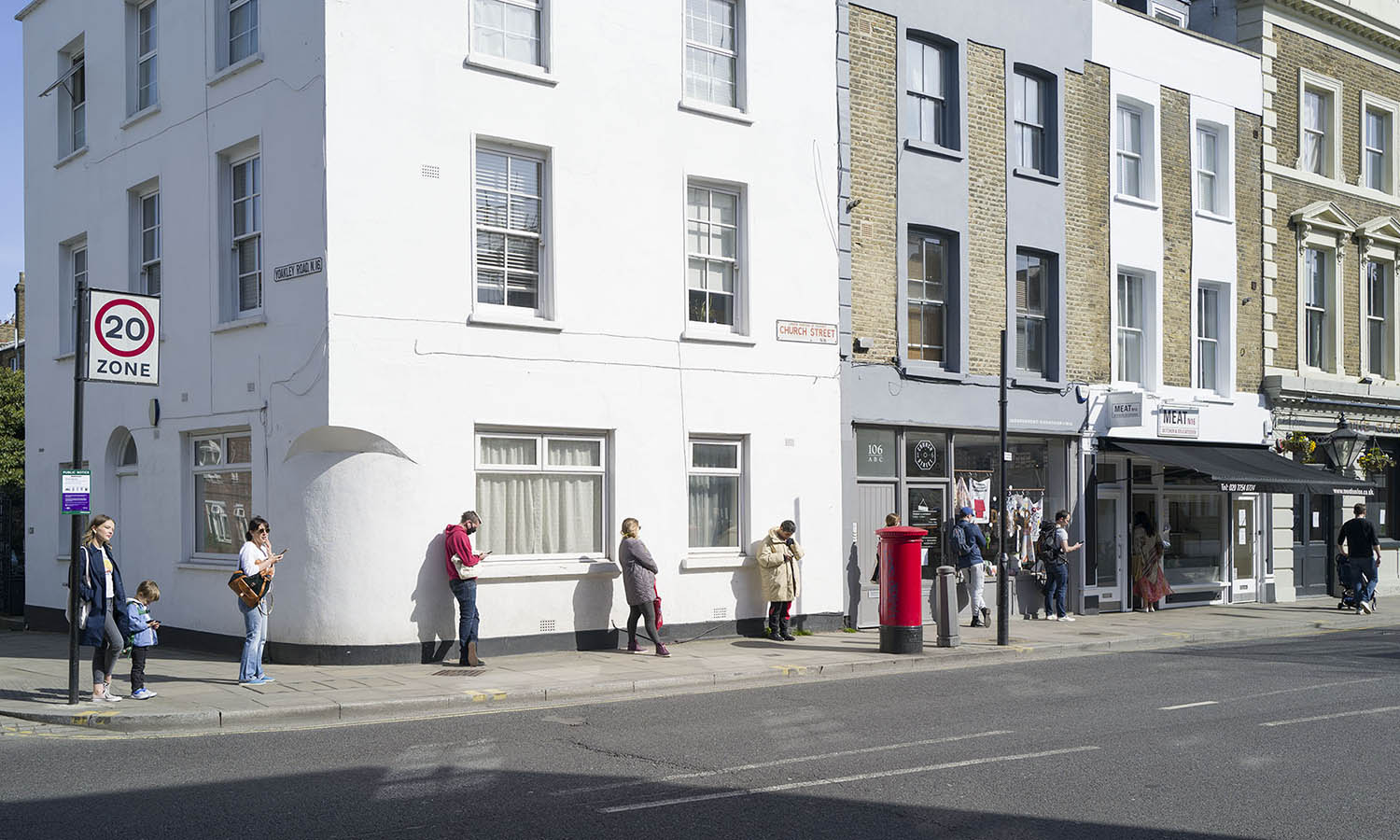
by the Gentle Author
Photographer Agnes Sanvito sent me this series of her pictures of queues


“For the past few years, I have been documenting people queuing to board a bus, buy a coffee or see an exhibition and most recently, during the current lockdown, for all essential needs.
Coming from Italy, queueing is an alien phenomena to me. No one else queues as the English do. Hungarian-born British author George Mikes wrote, “An Englishman, even if he is alone, forms an orderly queue of one.”
My fascination with queues starts with how people organise themselves into a fair and orderly line. Within this framework, different quirks of behaviour and posture emerge, people are checking their phones, reading, kissing, or just simply staring at the line and feeling satisfied that the queue grows.
Since the lockdown and the requirement of two metre distancing, the lines are growing even longer at local groceries, DIY shops, post offices, pharmacies and supermarket in my neighbourhood.
I hope my pictures lift you up and grant a new perspective on this strange yet significant moment we are living through.” – Agnes Sanvito


See more by the Gentle Author


Where We Hang Out
Get in Touch
Working alongside


