
International Woolmark Prize
from one of our favourite creative studio’s Factory Fifteen
Factory Fifteen directed the campaign for the 2017-18 International Woolmark Prize in Florence. The task was to develop a theme and visual identity for the awards which spoke of innovation and was loyal to the brand.
Factory Fifteen came up with a single motif: ‘DISRUPT THE THREAD.
They applied this motif to several pieces of content for the live show and digital, including a choreographed catwalk projection sequence, an interactive installation, graphic design, website assets and social media posts. Factory Fifteen worked in tandem with event producers OBO and the lighting designers.
SHOW REVEAL SEQUENCE
Their approach to the stage, where the collections would be revealed was to create an animated curtain of thread. This thread acted much like a theatre curtain, hiding the stage itself and animating/disrupting subtly before the show. During the reveal itself, the thread comes to life. Factory Fifteen created a 3 minute animated sequence which was timed to models walking out onto a purpose-built stage. Then developed 12 different techniques of digitally animated thread which represented the 12 nominees and their innovative approach to the design and manufacture of wool. A transparent gauze was used as the projection surface to envelop the models in the animation as they walked out.
INTERACTIVE
Factory Fifteen wanted to encourage people to participate in the show as well as continue the theme in a playful way. We created an interactive wall of thread which disrupted by proximity and body movement. The disruptive effect evolved throughout the evening and exploded with colour after the show.
GRAPHICS
The motif was simplified to a bold line style which was used throughout the event including designer stands where the designer collections were judged. We produced unique assets for each designer.
Luftraum
From Dirk Koy
Dirk Koy founded the studio for motion design and experimental film . In his work, he uses different technologies (drones / 2D and 3D animation / photogrammetry / AR / VR) to create moving digital images. He investigates the interface between reality and virtuality and is also looking for the painterly component in the digital context. The Experiment plays a central role. His work has been shown at the Art Center Nabi in Seoul, at the HeK (House of Electronic Arts) Basel, at the Supernova festival in Denver or at the FILE Festival in São Paulo. In 2019 Dirk Koy received the Basel Media Art Prize for the work «ground».
Experimental Film by Dirk Koy
D.N.W. Chapter 2
Part 2: Art film by experimental collective Deeds Not Words
Wishing you all well for International Women’s Day 2018. Today we are thinking of the women and girls who inspire us to take action and make changes in our lives. We made this video to show our gratitude to the women past and present, from around the world who have risked everything for equality. Rise-Up Women! Deeds Not Words.
Throughout 2018 D.N.W. will unleash a string of filmed guerrilla performances and artworks in London, Manchester and other UK cities, that will mark 100 years since the Representation of the People Act was passed, granting some women over 30 in the UK the right to vote for the first time.
“Like 21st Century Suffragettes we harness our creative daring to honour our heroines both past and present. We do this in intrepid and colourful ways, via #art #activism #music #dance #film, highlighting the stories of the women’s suffrage movement through a 21st Century lens. Our aim is to energise a new wave of activists with a shared vision for gender equality, celebrating all that the Suffragettes achieved as well as highlighting what is left to be done. Motivated by the call to action ‘deeds not words’ adopted by the pioneering Suffragette Emmeline Pankhurst we call ourselves D.N.W. ”
See part 3 here
Consumed: Facing the Underbelly of Western Consumption
“The ecological crisis we face is so obvious that it becomes easy,” writes philosopher Timothy Morton in his book, The Ecological Thought, “to join the dots and see that everything is interconnected.” From the microscopic to the macroscopic, and beyond to the unfathomably big, everything on this planet is entangled in an unimaginable set of relations. Morton conceptualises this as a mesh. The term, he says, suggests “both hardness and delicacy”, where there are connective threads but holes as well, suggesting how not everything in the mesh may be linked but also that there may be spaces in what we understand. This is quite an idea, and one that can feel rather unsettling, but Morton argues that we must begin to grapple with this interweaving, mixing and mingling if we are to confront and deal with the age in which we live – one which has the reality of environmental damage pressing up hard against it.

What this means is we must begin to think big and try to understand what constitutes our familiar world by shifting gear slightly and confronting the strange and unfamiliar. The actually not so faraway places and the effect our actions have on them.
One means that Morton outlines for beginning this task is – maybe obviously – scientific experiment, but he also stresses the value of artistic practices in beginning to help us confront some of the biggest challenges of our time. One photographer and filmmaker who can be seen to pick up the mantle of thinking ecologically is Richard John Seymour, whose 2016 BAFTA-nominated short film Consumed looks at the landscapes, mines, factories and shipyards that make up production in China.

Seymour studied at the Architectural Association under the tutorage of Liam Young and Kate Davies, who run a speculative design studio at the school called Unknown Fields Division. The studio works with writers, designers and architects and ventures, “out on expeditions to the ends of the earth to bear witness to alternative worlds, alien landscapes, industrial ecologies and precarious wilderness”. They aim to make apparent the relationship between the landscapes, and supply chains that come to support contemporary cities, which are often unseen, or imperceptible. Active since 2008, Unknown Fields Division have conducted field trips travelling extensively. This has included lithium mines in Bolivia, textiles factories in India and Bangladesh, gemstone mines in Madagascar, and precious metals mines in Western Australia. Unknown Fields Division are preoccupied by how envisioning such places and relationships can come to alter perceptions, and be generative for speculation: how understanding the entanglement of here and there can help develop new cultural relationships with climate change and the by-products of industry.
It was on one of these fieldtrips that Seymour filmed the material for Consumed. Seymour began filming the factories and mines that they visited in Inner Mongolia and China primarily as a form of documentation. But Seymour amassed enough footage to make a film, which in collaboration with Young and Davies he then turned into Consumed.
Whilst Seymour was studying undergraduate architecture at Bath University he became more and more interested in images as opposed to actually designing. Seymour felt that producing images could come to form a critique of issues that the architectural discourse he was in did not address. Seymour explains that at university, “there was a big focus on style and form. It felt a bit like architecture was a bit of a window dressing, and that was its main capacity. It was almost to entertain,” and that with his photography he was, “trying to find out what was going on outside of the architectural world.” In particular, the ‘starchitetural’ world spearheaded by the likes of Frank Gehry, Norman Foster and the late Zaha Hadid.

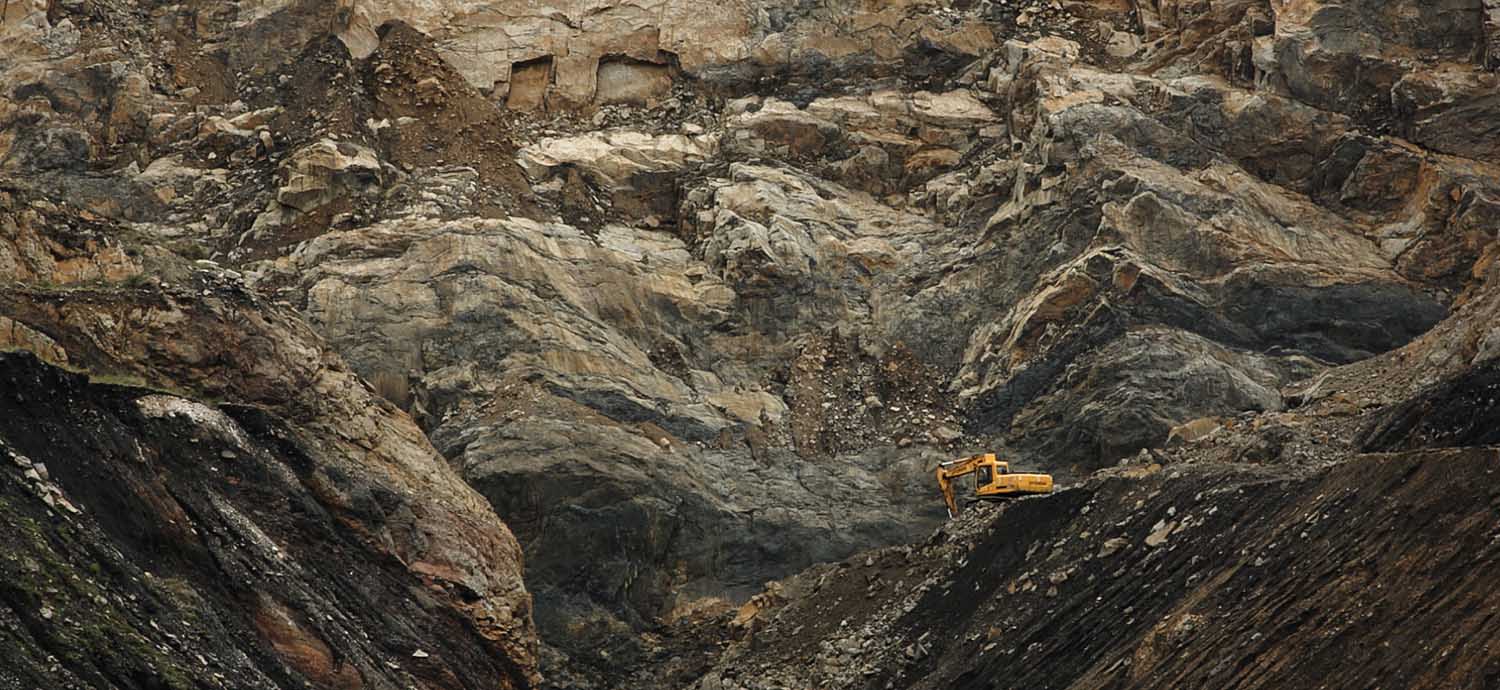
Consumed is Seymour’s most recent move away from this slick architectural world of surface, and a cinematic one at that. The film opens with a shot of a digger, perched on the edge of a mine’s slope, moving scree with the bucket on the end of its jolting mechanical arm. In the next scene waste pipes belch blackened water out onto an artificial lake. The lake is constituted of the tailings material (what is left after the process of separating the valuable material from the mass of the ore which has been extracted) from a mineral refinery in Baotou, Inner Mongolia, that extracts rare earth minerals for the production of electronics. These scenes are a set up for the rest of the film, which moves quickly from the mines of Inner Mongolia, to a factory in China’s Jiangsu Province. There is a sense of unsettling vastness in all of these operations, visible through how the size of the mine dwarfs the digger and the expanses of factory floor.

A departure point for Seymour when thinking about the China trip was the work of photographer Edward Burtynsky, whose photography aims to achieve a similar ‘drawing to attention’ as Consumed and Unknown Field Divisions work. There is a similar sense of an ‘architectural scale’ in Seymour and Burtynsky’s work too. Seymour’s shots of endless shipping containers parallel Burtynsky’s images of industrial sprawl. Although in Burtynsky and Seymour’s work the intention is to point to the impact of these landscapes and places, they are portrayed in such a way that they take on an odd beauty. There is a friction here between the desire to depict the consequences of development and consumerism and the portrayal of industrial and polluted landscapes, which leads to sense of an almost industrial sublime.

Consumed manages to avoid remaining entirely in this mode however through the character of Chen Li Ming, who we hear describing his life working in the factory, over the repetitive din of machines. Chen Li Ming explains how he has worked in the factory for 11 years, and that his hands are his livelihood; the factories in China have not caught up with the automation in countries like South Korea. He speaks of how hard life in the factory is, but he also talks of how proud he is of the work he does. As he speaks the scale of production becomes clear as the camera pans rooms full of gold, silver, red and green Christmas baubles, and closes in on a worker sewing a beard onto a Santa’s bare face. It is October, and Chen explains that it is the busiest time of the year as the factory prepares goods for the Western Holidays.
Despite the scenes with Chen Li Ming appearing as a straight forward character profile one would expect in documentary film, Chen is fictitious and was built through interviews Seymour conducted with different factory workers. This was a result of being unable to get a decent sit down interview and the difficulty of trying to talk to people whilst they worked. But it was also due to the fact that Seymour’s interviewees were often being overlooked by their bosses, meaning they rarely divulged the reality of their workplace. But Seymour feels, “it was one of those situations where fiction became more true than fact”. The stitching together of different stories and thoughts from different people in the factory creates a rounder depiction, and a better insight into life working in a Chinese factory.

Consumed takes the fiction-truer-than-fact approach throughout. It is a meshwork of narratives and disparate scenes, coming together to form a vision we would not otherwise see or be able to quite conceive. It does this in part by exposing the phantasmagoria of commodities and the stories behind their magical apparition. We see the dirty process of mineral extraction that sits behind the superficial cleanliness of our phones screens, and the labour that goes into festive ornamentation. Through Chen Li Ming it also reveals the life of a factory worker in a factory, as well challenging perceptions of what that may be like. It brings to light what Morton says “we don’t like to recall”, and reframes what is familiar (technology and Christmas) in relation to what is unfamiliar (mining and factory production).
It can be seen to achieve what Morton describes as the role of artworks for thinking ecologically: they enable a questioning and disrupting of a known reality, through exposing one’s complicity in ecological conditions. Yet Consumed also suffers in a way that film, photography and art that takes the brave move of trying to portray the complexity of supply chains, environmental damage and vast industrial landscapes often do. Despite the horror of what is being portrayed, a strange majesty is evoked. There is a closing of distance in one sense, but an opening in another.
Words: Stan Portus
D.N.W. Chapter 1
An art film by experimental collective Deeds Not Words
Deeds Not Words will gallop across the UK. D.N.W are 21st Century Suffragettes. Celebrating heroines past & present via #art #activism #music #dance #film. Be watchful…moving in the shadows D.N.W.
See Part 2 HERE
See Part 3 HERE


